|
“ACTING” TECHNOLOGY F A Q - Frequently Asked Questions
CONTENTS:
DearSir/Madam, Dear colleagues and partners of our firm! Technical progress, variable consumer tastes and new legislation – e.g. in ecology – these are only some of the reasons why we should constantly try to improve our products so that they meet the new requirements. Apart from these new demands we, in Acting, try to optimise manufacturing and the manufacturing process. This results in the fact that time and again, we are able to present more up-to-date results. We would like to use this “Acting” booklet to present
to you our main product: high-quality pavement. Wishing you every success! THE “ACTING” GROUP
2. THE “ACTING” TECHNOLOGY PROGRAMME Concrete technology is a scientific and technical discipline that deals with the composition, manufacture and characteristics of concrete with the aim of achieving the required characteristics with the minimum energy consumption and minimum pollution of the environment. This technology will help you to treat your garden or area around your house in such a way that it will bring you pleasure for many years to come. Where natural ground does not meet our requirements, further treatment and stabilization become necessary. The technology offers everything that architectonic surface treatment for different shapes and sizes could require. It is in harmony with its surroundings because they are of the same kind – natural – consisting of natural materials such as stone or sand … The pavement has a long service-life; it is clean, easy to maintain, and has high durability. It is also ecological, reusable and universal. Our products are made of concrete, a material that has a wide range of use in our environment. Concrete is the most frequently used building material, often called “artificial stone”. The Czech word for “concrete” (beton) was adopted from the French expression "béton" (dab); originally it comes from the Latin word "betunium" (stone mortar). It is a framework of artificially made stone, consisting of natural materials (sand, gravel, water and cement that is made from limestone) and has many possibilities in terms of shaping. It is a technology for concrete elements with standard possibilities for manufacture of the following products: concrete pavement of various shapes and heights from 2.5 cm to 8 cm terrazzo plates of various sizes and heights from 2.5 cm to 5 cm concrete curbs up to 50 cm concrete drains for water outlets concrete wall facing, plain or stone imitations balustrades – concrete balusters other new products for firms that wish to be independent and have their own programme for manufacture and subsequent sale of attractive products for firms that wish to be independent and have their own programme for manufacture covering their own needs, where the finished products are built in the finished buildings for firms that need to cover certain periods of time with labour power and have their own supplementary manufacturing programme for firms that have material at their disposal and want to use it (build it into a structure) and have their own supplementary manufacturing programme for private entrepreneurs who wish to have their own manufacturing programme for private entrepreneurs who wish to have a supplementary programme for do-it-yourself enthusiasts who wish to manufacture the products themselves for their relatively high consumption The lifespan of a mould depends on the manner of its application; with normal use, the minimum lifespan of a mould is approx. 300 uses, i.e. expressed in time with a daily cycle it lasts approx. 3 years (i.e. 900 working days). The normal life of the mould depends again on the manner of its application, material and maintenance, and is approx. 600 uses, i.e. approx. 6 years.
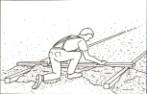
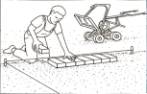
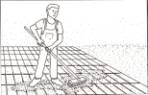
First of all it is necessary to stabilize the rough base, also taking into account later drainage of a minimum of 0.5 % of a slope lengthwise and 2 - 3 % of a slope width wise. That means 0.5 cm, respectively 2 - 3 cm, difference per 1 m. An anti-frost layer with a grain size of 0 – 55 mm is applied on the ground, and then it is consolidated. The layer thickness depends on the local conditions (frozen soil depth). Upon it a fine bearing bed with a grain size of 0 - 18 mm is applied and thoroughly fixed/rolled. This layer should also fit the subsequently required terrain slope; the maximum deviation must not be higher than +/- 1 cm. The layer thickness is approx. 10 cm.
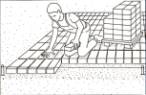
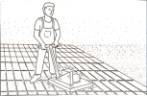
The surface can be used immediately. The sand should be removed after a period of one month.
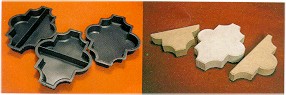
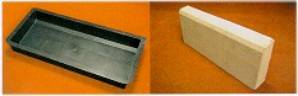
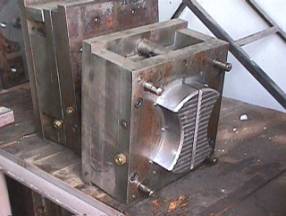
They are made of special plastic, the composition of which ensures high durability and long-term use of the moulds. They are sufficiently strong to hold concrete in shape as well as sufficiently elastic so as not to break during handling. This is not the case with the majority of competing companies, which have cheaper imitations and different technology, and that is why they cannot compete with our moulds. Our products are based on long-standing manufacturing experience with a secret composition means we have a large number of satisfied customers.
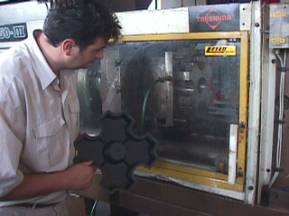
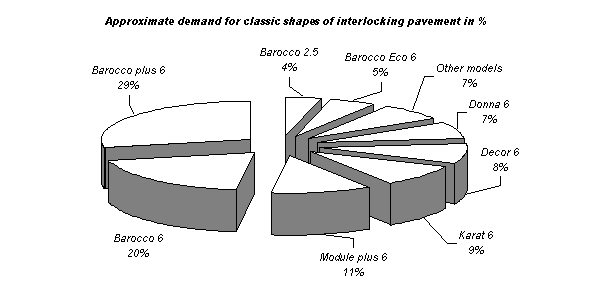
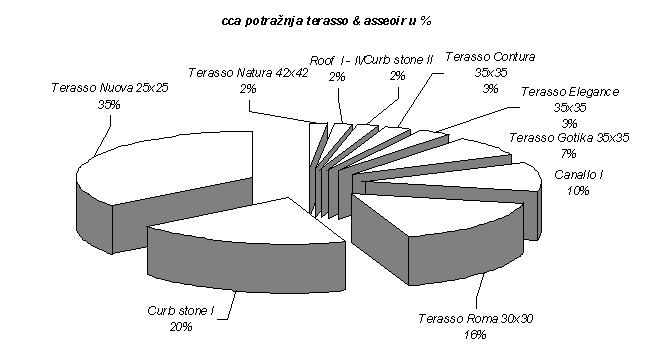
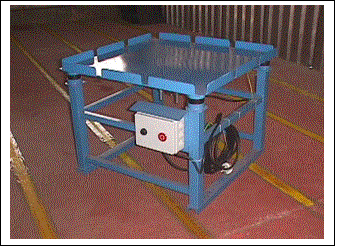
4.1.1. Packaging The plastic moulds are normally delivered in packs of 10. 4.1.2. Graphic chart of the most frequently used mouldsThe chart serves as a tool for the selection of moulds. It shows the average of total production for all markets. It is a universal piece of manufacturing equipment for concrete products of various shapes across the whole programme. The table structure is simplified to a great extent and consists of a minimum number of parts. Thanks to this in the event of failure, it reduces the cost of maintenance and increases the return on investment. The probability of failure and work stoppage thus becomes minimal. The table is made of steel profiles; its solid plate and special structure enable the optimum vibration transfer to the whole table surface. Special spring mounting reduces the vibrations in such a way that they are not transferred to the table base. Thanks to this noise during created manufacture is silenced. The vibrations required for the manufacture of concrete products are produced with the help of an electric vibration motor that has out-of-balance weights on its axle. By changing the position of these out-of-balance weights, the power of vibrations can be regulated. The vibration motor is switched on with the help of a protective relay that is activated by a time-regulated switch – a timer. The time of vibrations can be adjusted. After the set time elapses, the switch automatically stops the operation of a vibration motor. The table should be aligned horizontally. 4.2.1. CapacityThe OPTIMA AG 2000 produces approx. 10 - 16 m2 of concrete pavement per hour. The dimensions of the working vibration plate are 1000 mm x 1000 mm, which means approx. 0.8 m2 of pavement (that is an average coefficient). The vibration cycle lasts approx. 3 minutes with 1-3 cm-high moulds (loading, filling, vibrating and unloading), which means approx. 20 cycles of 0.8 m2 each, i.e. 16 m2. For the height of 4-8 cm, two cycles are used. This lasts approx. 5 minutes (one stacking is skipped), which means approx. 12 double cycles – approx.10 m2. 4.2.2. Packaging
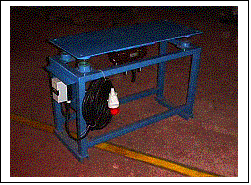
The table is packed in a protective stretch foil. It is universal for every shape provided that every time the corresponding tools are used for shaking-out of various models (the upper plate of the table is changed). 4.3.1. CapacityThe MAXIMA AG 2000 produces approx. 20 - 40 m2 of pavement per hour 4.3.2. Packaging
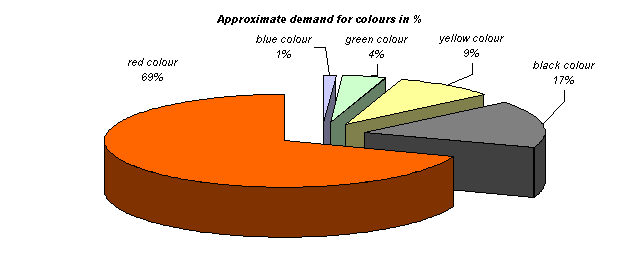
The table is packed in a protective stretch foil It is a brown liquid or a yellow to brown powder, used to achieve better quality, hardness, and resistance to frost and other influences to which the finished product is exposed. 4.4.1. PackagingThe liquid plasticizer is normally delivered in 200 l barrels and the powdered plasticizer is delivered in 25 kg bags. The powdered pigments (metal oxides) are normally used for dying of concrete elements. The dosing is approx. 1- 5 % of the cement quantity depending on the quality of the colour, manufacturer, used material and the required shade. The standard offer includes: red colour yellow colour black colour green colour blue colour White colour is normally not used; for this purpose white cement is mostly used. 4.5.1. PackagingPigment is normally delivered in 25 kg bags. 4.5.2. Graphic chart for demand for coloursThe chart serves as a tool for selection of a colour. It shows the average of total production of all markets. The fixed cost is the total cost related to manufacture in a certain period of time, excluding material consumption and labour. Usually it is a month, i.e. approx. 22 working days. The expenses cover rent, water supply, power supply, telephone, etc. The variable cost is the total cost related directly to manufacture in a certain period of time. Usually it is a month, i.e. approx. 22 working days. The expenses cover the material and labour costs, costs of water supply, power supply, telephone, etc. This is a rough calculation for approximately 1,000 m2 of concrete pavement 6 cm in height. To find out the individual cost, add the market price to the table and calculate the cost of a sample.
The budget is just for your information (compiled on the basis of our gained experience) to help you with your calculation.
- a roofed (enclosed) space – approx. 50 m2 depending on the quantity of moulds and on the required daily production - electric power supply of 380V - water supply - quarry stone from 4-8 (8 - 16) mm, depending on the element type, its height (thickness) and/or proportion of big and small fractions in aggregates - sand of 0 - 4 mm - Portland cement min. 42.5 - plasticizer - colour/pigment We recommend a minimum of 3 people, depending on production quantity. - a device for concrete preparation, e.g. a concrete mixer (minimum of 150 l of working volume) - a container for concrete transport, e.g. a wheel-barrow - a device for handling, e. g. a hand-cart - hand tools, e. g. a shovel, a trowel, a mortar trough – a scoop, a broom... - material batcher – for fractions, e.g. a bucket - material batcher – for plasticizer, e.g. a measuring cup - for packing of the finished products, e.g. Europallets, wrapping foils - consumable supplies for the workers, e.g. clothes, gloves
The terms and conditions apply to all customers, unless other conditions are agreed upon in written form. Goods are delivered after placing your written order, which should include the following information: - Type of goods, catalogue name or product number - Quantity of goods - Destination and manner of transport, or delivery term according to Incoterms 2000 - The required delivery date of goods Upon receipt of your order an advance invoice – a pro forma invoice - is issued which includes: - Goods description, catalogue name or product number - Quantity of goods - Possible destination and manner of transport, and/or delivery term according to Incoterms 2000 - Possible date of goods delivery The prices are set by a valid pricelist in EUR – equivalent to FCA Znojmo, Incoterms 2000. Payment for goods according to the given details of payment in favour of: ACTING spol. s.r.o., Rudoleckého 25, 669 02 Znojmo, Czech Republic Bank account no. (EUR): 195077620227/0100 Bank address: Komerčni banka Znojmo, Nám. Svobody 18, 670 37 Znojmo, Czech Republic Swift code: KOMB CZ PP Delivery – take-over of goods follows after the receipt of the settled amount to our foreign currency account in the due term according to the settled delivery term of Incoterms 2000. Two delivery terms are normally used: FCA Incoterms 2000: place, state (of take over) – loaded and customs cleared at EXPORT DDU Incoterms 2000: place, state (the order came from), delivery to the destination with the corresponding payment – not loaded and not customs cleared at IMPORT provided that the seller’s duties are completed under the delivery term, e.g. importer registration – customs no., import licence (if required), border crossing and customs clearance place, or forwarder that arranges all import formalities. Responsibility for goods passes to the consumer after take-over of the goods according to the delivery term. A complaint regarding the quantity and quality of goods can be filed in accordance with the corresponding rules in force of ICC (International Chamber of Commerce) and the WTO (World Trade Organization): - for quantity and quality – visible damage at the goods take-over - for quality – damage invisible at first sight within 7 days from the take-over in written form The Acting company takes responsibility for the quality of goods. Acting does not take responsibility for damages caused during transport (except for in relation to the delivery terms according to Incoterms 2000) or caused by improper handling or improper use. The Acting company gives a 12-month warranty for technology (plastic moulds, vibration tables, electric motors). The warranty comes into force from the day of take-over, or according to the delivery term. |
||||||||||||||||||||||||||||||||||||||||||||||||||||||||||||||||||||||||||||||||||||||||||||||||||||||||||||